How to Get More Customers for Your Toronto Small Business in 2026
Elvis - Thu Aug 13 2026
Running a small business in Toronto in 2026 is harder than it looks from the outside.
The city is growing. Foot traffic is back. The post-pandemic recovery has made Toronto one of the most active commercial markets in North America. On paper, the conditions for a thriving local business have never been better.
But most small business owners in Toronto are not feeling it that way.
They are posting on Instagram consistently and watching engagement stagnate. They are paying for Google Ads and struggling to tell whether it is working. They are handing out flyers, running local Facebook ads, and wondering why new customers are not walking through the door at the rate the effort should justify.
The problem is not effort. The problem is visibility.
Toronto has more businesses competing for the same customers than at any point in the city's history. A restaurant on Queen West is not just competing with the place next door. It is competing with every other option a customer has on their phone at the exact moment they are deciding where to go.
Getting more customers in Toronto in 2026 is not about working harder on the channels you are already using. It is about showing up in the places your competitors have not found yet.
This is the complete, honest guide to getting more customers for your Toronto small business in 2026, from someone who works with local businesses every day.
The Honest Reality of Small Business Marketing in Toronto Right Now
Before the playbook, the reality check.
Most Toronto small businesses are over-invested in one or two channels and completely invisible everywhere else. The typical pattern looks like this. A restaurant or retail store pours time and money into Instagram, gets decent engagement from existing followers, and then wonders why it is not translating to new customers. Or a service business runs Google Ads, gets clicks, but cannot convert them at a rate that justifies the cost per click.
Both of those channels work. Neither of them is enough on their own.
Instagram reaches people who already know you exist. Google Ads reaches people who are already looking for what you sell. Neither of them reaches the person who does not know you exist and is not currently searching for you, but would absolutely walk through your door if they saw your business at the right moment.
That is the gap. And filling it is where most Toronto small businesses find the biggest untapped growth.
The Customer Journey Most Toronto Businesses Are Missing
Think about how a new customer actually finds a local business in Toronto in 2026.
They might search Google when they have a specific need. They might see a social media post from someone they follow. They might walk past your storefront and notice something that stops them. They might remember a name they have seen before and think of you when the moment is right.
Most small business marketing in Toronto covers the first two touchpoints and completely ignores the last two.
The businesses getting more customers consistently are the ones creating physical world visibility alongside their digital presence. Not replacing social media and Google, adding the layer that reaches people in the real world before they are ever searching.
The Toronto Small Business Marketing Stack That Works in 2026
This is the combination that fills both online and offline gaps without requiring an agency budget or a marketing team.
Foundation: Google Business Profile
This costs nothing and it is the most important thing on this list.
Over 46% of all local business website traffic comes from Google Maps and Google Business Profile searches. If your profile has outdated hours, no photos, and no recent posts, you are losing those customers to the business down the street whose profile is complete.
A fully optimized Google Business Profile in 2026 includes current hours updated for every holiday and seasonal change, at least 20 high-quality photos of your space, products, and team, a direct booking or contact link, weekly Google Posts highlighting a current promotion or update, and active responses to every review, positive and negative.
This is free. It takes 30 minutes to set up properly and 10 minutes a week to maintain. If you have not done this yet, do it before anything else on this list.
Content: Instagram and TikTok Posting Consistently
Not boosted posts. Not paid ads. Just consistent, genuine content posted three to five times a week minimum.
The content that works for Toronto small businesses in 2026 follows a consistent pattern. Short video outperforms photos every time. Behind the scenes content builds trust faster than polished brand posts. Neighbourhood-specific hashtags reach local audiences that generic tags miss entirely. And posting at the right time, 10:30am for lunch promotions, 7pm for evening and weekend content, dramatically increases how many of the right people actually see it.
The goal of social media is not to go viral. It is to be the business that a Toronto customer already recognizes when they are deciding where to go.
Visibility: Digital Screen Advertising
This is the layer most Toronto small businesses have not considered yet, and it is where the biggest gap in local marketing exists right now.
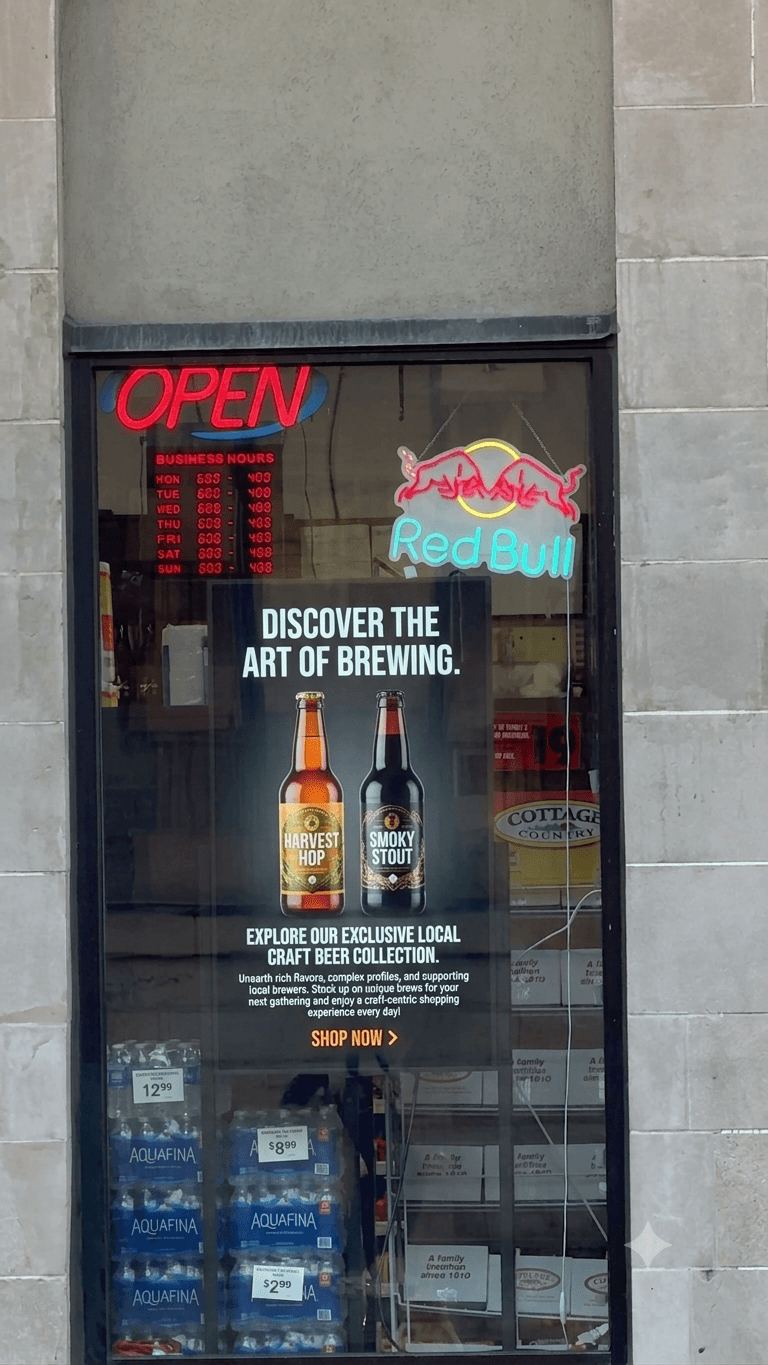
A HotCrowd digital screen on Queen Street West or Blue Jays Way near Rogers Centre reaches over 30,000 people a month walking and driving past a single location. Not people who already follow you. Not people already searching for what you sell. People who are physically present in a Toronto corridor right now, deciding what to do next.
Your existing Instagram and TikTok content plays directly on the screen. No new production. No agency. No long-term contract. Your ad is live within 24 hours of upload.
A restaurant running a lunch special on screen at 11:30am reaches a hungry office worker deciding where to eat before they open their phone. A dentist running a new patient promotion on Eglinton Avenue reaches a commuter walking to the subway who has been meaning to book a cleaning for months. A realtor running a just-sold announcement on Queen West reaches every homeowner in that neighbourhood who now has one more data point that this agent closes deals nearby.
This is the channel that fills the gap social media and Google leave open. Physical presence. Real world visibility. Reaching people before they are searching, not only when they already are.
Conversion: A Simple, Direct Online Presence
When a potential customer sees your business on a digital screen, on Instagram, or on Google and decides to take action, the path from interest to booking or visit needs to be frictionless.
A QR code on your HotCrowd screen that goes directly to a booking page, not a homepage. A Google Business Profile with a direct call or book button. A website that loads fast, shows your hours and location clearly on the first screen, and has one obvious action to take.
Every extra click between interest and conversion loses a customer. The businesses winning in Toronto in 2026 have made that path as short as possible.
What This Looks Like for Different Toronto Business Types
The same stack applies across every local business category, adjusted for the specific customer and the specific decision moment.
Restaurants and cafes: Google Business Profile for "near me" searches, Instagram for dish highlights and specials, a digital screen near your location running your best visual content at peak meal decision times, and a direct booking or order link on every touchpoint.
Dental clinics and healthcare practices: A complete Google Business Profile with reviews and booking link, consistent social content showing your team and environment, and a digital screen in a commuter corridor near your practice running a new patient promotion with a QR code to your calendar.
Med-spas and aesthetics clinics: Instagram and TikTok content showing results and treatments, a digital screen reaching high-income Toronto audiences in Yorkville, King West, or Queen West corridors, and a direct booking link attached to every piece of content.
Realtors: A Google Business Profile with current reviews, consistent social media content showing your listings and results in specific neighbourhoods, and a digital screen running your farm area brand campaign with your face and track record on a loop in the neighbourhood you are trying to own.
Retail stores and boutiques: Instagram content showing new arrivals and the in-store experience, a digital screen on a nearby corridor driving walk-in traffic, and Google Shopping or a direct product link for anyone who finds you online first.
Service businesses: Reviews and Google Business Profile as the primary discovery channel, social media for trust-building, and a digital screen near your service area for local brand recognition before a customer needs you.
The Mistakes Most Toronto Small Businesses Are Making Right Now
Being direct about this saves time and money.
Boosting Instagram posts without a strategy. A boosted post with no specific offer, no defined audience, and no clear action is an impression that converts no one. Put that same budget on a digital screen and it reaches a larger, more locally relevant audience with content that cannot be scrolled past.
Ignoring Google Business Profile. This is the highest-return free marketing tool available to any Toronto small business and most profiles are incomplete, outdated, or have unanswered reviews sitting on them.
Waiting to advertise until things are slow. The businesses with consistent customer flow are the ones who advertise consistently, not the ones who burst when they need a boost. A monthly digital screen campaign compounds in the same way a social media following compounds. Visibility that is always on builds more than visibility that turns on in a panic.
Printing promotional signage that is outdated before it is installed. A printed window poster takes days to design, print, and hang. A HotCrowd digital window screen at hotcrowd.ca updates in ten minutes. The promotion that launched this morning is live on screen before the lunch rush.
If you are a Toronto small business owner ready to add the channel that fills the gap between your online presence and your physical street, HotCrowd is built for exactly this.
No agency. No minimum spend. No long-term contract. Your existing social media content is all you need.
View available Toronto screen locations and start your campaign today: hotcrowdadvertising.com/digital-advertising-management
Interested in a digital window screen for your own storefront: hotcrowd.ca
Browse HotCrowd screen locations across Toronto: hotcrowdadvertising.com/billboards
Frequently Asked Questions
What is the best way to advertise a small business in Toronto? The combination that consistently delivers the strongest results for Toronto small businesses in 2026 is a complete Google Business Profile, consistent Instagram and TikTok content posted three to five times a week, and a digital screen in a high-traffic Toronto corridor reaching local audiences in the physical world. Each channel handles a different stage of the customer journey.
How much does it cost to advertise a small business in Toronto? Google Business Profile is free. Consistent social media content costs only your time. HotCrowd digital screen advertising starts well below traditional billboard and transit shelter rates in Toronto, with no long-term contracts and no agency fees. Contact HotCrowd for current pricing based on your specific location needs.
How do I get more foot traffic to my Toronto store? Digital screen advertising on a nearby high-traffic corridor is one of the most direct ways to drive foot traffic to a Toronto storefront. A 15 second video reel playing at peak traffic times with a clear offer and QR code reaches people physically near your location at the exact moment they are deciding where to go.
How long does it take to see results from local advertising in Toronto? Google Business Profile improvements show results in days to weeks. Social media compounds over three to six months of consistent posting. Digital screen advertising builds brand recognition from day one, with immediate impressions and QR code tracking showing engagement within the first campaign period.
Is digital advertising better than print advertising for Toronto small businesses? For most Toronto small businesses in 2026, digital advertising delivers stronger results at lower cost than print, primarily because it is updateable, trackable, and reaches a more targeted local audience. HotCrowd's digital screens specifically eliminate the production delay and reprinting costs that make print advertising inflexible and expensive to maintain.
HotCrowd is Toronto's self-serve digital out-of-home advertising platform. We help local businesses get visible in the real world, reaching customers in high-traffic Toronto corridors without agency fees or long-term contracts. Learn more at hotcrowdadvertising.com or visit hotcrowd.ca for digital window screen inquiries.