Digital Out-of-Home Advertising in Toronto: The 2026 Guide for Local Businesses
Elvis - Wed May 20 2026
What Is Digital Out-of-Home (DOOH) Advertising?
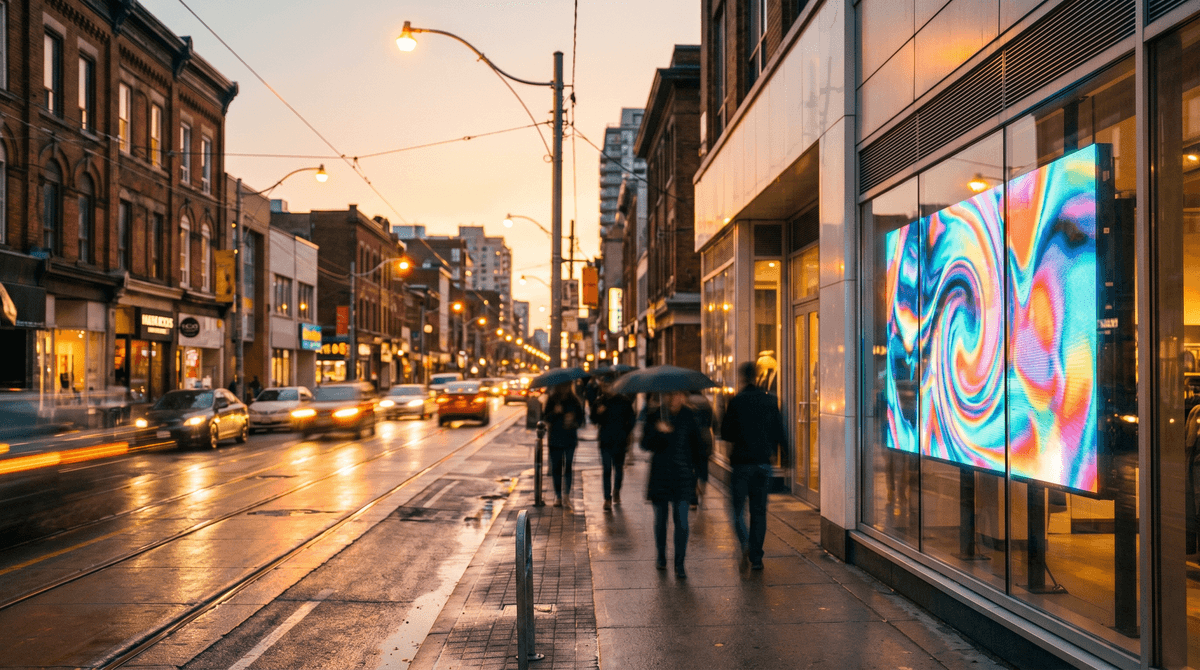
Digital out-of-home advertising refers to any ad content displayed on digital screens in public spaces, think digital billboards, window-facing LED screens, in-store displays, and street-level signage. Unlike traditional print billboards, DOOH screens display video or animated content, can be updated instantly, and can run multiple advertisers on a rotating basis.
The key difference from online advertising? You can't skip it, scroll past it, or block it. When someone walks down Blue Jays Way before a game, your ad is just... there.
In Canada, DOOH ad spending has grown significantly year over year as more small and mid-size businesses discover that physical-world visibility drives measurable results especially when combined with digital campaigns already running on Instagram and TikTok.
Why Toronto Is One of the Best Cities in Canada for DOOH
Toronto's density is its superpower for advertisers. With over 2.9 million residents in the city proper and millions more in the Greater Toronto Area, foot traffic in key neighborhoods is consistently high and it's concentrated in predictable corridors.
Areas like Queen Street West, Yonge & Dundas, King Street, and the Rogers Centre/Blue Jays Way strip see tens of thousands of pedestrians daily. For advertisers, that means your 15-second video ad can generate 30,000+ monthly impressions from a single screen placement in the right spot.
For local businesses, restaurants, realtors, beauty brands, fitness studios, retail shops, and events that kind of repeatable, hyper-local visibility used to require a $10,000+ traditional billboard contract. Not anymore.
How DOOH Works for Local Businesses in Toronto
The traditional barrier to outdoor advertising was always production. You needed creative agencies, expensive shoots, and long lead times. DOOH has eliminated most of that especially when you're already creating content for social media.
Here's how the modern DOOH workflow looks for a local Toronto business:
Step 1 — Repurpose your existing content.
Your Instagram Reels or TikTok videos are already optimized for short-form, high-attention viewing. With the right screen partner, those same videos can run on a physical digital screen — no reshoots, no new production budget.
Step 2 — Choose your screen location strategically.
Location is everything in DOOH. You want a screen where your target audience actually walks. A beauty brand wants foot traffic near salons and boutiques on Queen West. A realtor wants visibility near a condo development corridor. A restaurant wants screens near transit hubs or entertainment districts.
Step 3 — Your ad goes live and stays flexible.
Unlike print, you can change your creative instantly. Running a weekend promotion? Update the ad. Launching a new menu item? Swap the creative the same day. DOOH gives you the flexibility of digital with the impact of physical.
Step 4 — Track results with QR codes and analytics.
Modern DOOH placements include QR codes that bridge the gap between the physical impression and a digital action — whether that's a website visit, a booking, or a follow. That means your outdoor ad is trackable, just like a Meta or Google campaign.
The Real Cost of DOOH Advertising in Toronto
One of the biggest misconceptions about digital outdoor advertising is that it's expensive. It used to be. A traditional static billboard in downtown Toronto can run anywhere from $3,000 to $10,000+ per month, with no flexibility and high production costs on top.
DOOH at the street level is a completely different price category and it's accessible to businesses with a fraction of that budget.
Here's a general breakdown of what to expect:
Street-level DOOH — screens placed in high-traffic storefront windows — offers the best entry point for local businesses. At 30,000+ monthly impressions per location, the cost-per-impression rivals or beats most paid social campaigns, with the added benefit of being impossible to scroll past.
Who Benefits Most from DOOH in Toronto?
DOOH isn't a one-size-fits-all channel, but certain business types consistently see the strongest results:
Realtors and real estate agents
Listing a property near a specific neighborhood? A digital screen in that area puts your listing in front of residents and passersby who already have local intent. Far more targeted than a Facebook ad reaching people across the GTA.
Restaurants and food businesses
Proximity is everything. A screen near your location or along a high foot-traffic corridor drives lunchtime and evening walk-ins in ways that delivery apps never will.
Beauty brands, salons, and spas
Visual businesses benefit enormously from video content displayed in real life. If your Reel already performs well on Instagram, it will convert even better on a screen right outside the demographic you're targeting.
Event promoters and local venues
Time-sensitive promotions are where DOOH's flexibility shines. Update your ad to promote tonight's event at 10am. No phone calls to a print shop required.
E-commerce brands building local brand awareness
Online-first brands increasingly use DOOH to drive brand recognition in specific markets especially Toronto's dense urban core before scaling digital campaigns.
DOOH vs. Social Media Ads: What's the Actual Difference?
This comes up constantly. Business owners who are already spending on Instagram and Meta ads often ask: why would I add DOOH to the mix?
The honest answer: they're not competing. They're complementary.
Social media ads target people when they're already on their phone scrolling, half-distracted, ready to swipe away. DOOH catches people in the real world, when they're present and physically near your location. Studies consistently show that brands using DOOH alongside digital campaigns see significantly higher brand recall and conversion lift than digital alone.
Think of it this way: your Meta ad plants the seed. Your DOOH screen on Queen Street is the reminder someone sees three hours later when they're walking past your neighborhood. That's not redundancy, that's sequencing.
And with DOOH, you're not fighting an algorithm. There's no bid war. No CPM inflation. No "your reach has been limited." You pay for the screen, you own that impression.
What Makes a High-Performing DOOH Ad?
Since most local businesses in Toronto are now running Reels on their screens, here's what separates the ads that stop people from the ones that get tuned out:
Motion in the first second.
Static openings get ignored. Start with movement, a product appearing, a face turning, a transition. You have one second to hook a pedestrian.
No dialogue dependency.
Most screens play without audio. Your ad needs to communicate clearly through visuals, text overlays, and branding alone.
One clear message.
This isn't the place for a multi-offer ad. Pick one: a promotion, a service, a neighborhood-specific message. Clarity beats cleverness every time.
A QR code with a destination.
Give pedestrians somewhere to go. A booking page, a Google Maps link, an Instagram profile. The QR code turns a passive impression into a trackable action.
Brand consistency.
Colors, fonts, and logo placement should match your overall brand instantly. You want someone who's seen your Instagram to recognize your screen ad immediately.
Frequently Asked Questions About DOOH Advertising in Toronto
How do I get my ad on a digital screen in Toronto?
The simplest path is working with a local DOOH network - a company that manages screen placements in high-traffic Toronto locations. You provide your video content (even a Reel), they place it on the screen, and you pay a monthly fee for the placement slot. Hotcrowd, for example, manages screens at locations like Queen Street West and Blue Jays Way, with spots available for local advertisers.
How long should a DOOH ad be?
15 seconds is the standard for street-level screens. It's long enough to communicate your message, short enough to respect a passing pedestrian's attention span. Many locations rotate multiple advertisers on a loop, so brevity also means more frequent impressions per hour.
Can I use my Instagram Reel as a DOOH ad?
Yes and it's one of the most practical advantages of modern DOOH. If your Reel is already formatted vertically or square and performs well, it can typically go directly onto a street-facing screen with minimal editing. Some platforms handle the formatting for you entirely.
Do I need to commit to a long-term contract?
It depends on the provider. Some networks offer monthly commitments with no long-term lock-in, which is ideal for businesses testing the channel or running seasonal promotions. Always clarify what the minimum term is and whether creative changes are included.
How do I know if my DOOH ad is working?
QR code scan tracking is the most straightforward method for street-level screens. You can also track spikes in direct website traffic, branded search volume, and Instagram follower growth in the weeks following a campaign. More sophisticated providers offer impression counts and loop frequency reports.
The Hotcrowd Approach: DOOH Built for Toronto's Local Businesses
Most traditional DOOH companies are set up to serve large national brands with six-figure budgets. Hotcrowd was built specifically for the other end of the market - Toronto's local businesses, realtors, emerging brands, and content creators who already have great video content and just need a real-world distribution platform for it.
The model is simple: you send your existing Reel or short video, Hotcrowd places it on a high-traffic digital screen in a location that makes sense for your business, and your content starts reaching real people in the real world — not just followers who already know you.
Current active locations include Blue Jays Way (near Rogers Centre) and Queen Street West - the two of Toronto's highest foot-traffic corridors with additional Yorkville and downtown locations expanding through 2026.
For businesses that want to go the other direction - turning their storefront into a revenue-generating screen - Hotcrowd's revenue-share model offers a free screen installation in exchange for hosting rotating ads, with monthly earnings passed back to the venue owner.
Ready to Put Your Brand on the Street?
DOOH advertising in Toronto doesn't require a massive budget, a production crew, or an agency retainer. If you're already posting Reels, you already have the raw material.
The question is: are those Reels only reaching people who already follow you or are they reaching the 20,000 people walking past a specific corner of Toronto every day?
Advertise your brand on Toronto's digital screens →
Get a free screen for your storefront →
View all active Toronto screen locations →